Appendix 2: Platform Comparison
Platform Comparison
Table [@tab:costTable] shows the computational costs for processing the same Common Crawl data batch on EMR and DBR. DBR outperforms other options, especially in compute-heavy tasks like edge processing. But it is much more expensive. This advantage cuts operational and development time. It may justify the premium for time-sensitive projects. EMR, on the other hand, is cheaper. It suits budget projects that need scalable data processing.
| Run | Step | Platform | Duration | Total Cost | Platform Surcharge | EBS Cost | EC2 Cost | Aggregated Total Cost | Aggregated Total Surcharge |
|---|---|---|---|---|---|---|---|---|---|
| 1 | nodes | EMR | 0.35 | $0.40 | $0.07 | $0.01 | $0.32 | $422.95 | $90.17 |
| 1 | edges | EMR | 9.99 | $402.54 | $80.19 | $13.72 | $308.63 | ||
| 1 | graph | DBR | 0.38 | $18.30 | $9.78 | $0.08 | $8.44 | ||
| 1 | graph_aggr | EMR | 0.27 | $1.71 | $0.13 | $0.02 | $1.56 | ||
| 2 | nodes | DBR | 0.23 | $0.50 | $0.13 | $0.00 | $0.37 | $784.64 | $252.74 |
| 2 | edges | DBR | 5.71 | $766.17 | $240.79 | $22.47 | $502.91 | ||
| 2 | graph | DBR | 0.38 | $17.04 | $11.61 | $0.26 | $5.17 | ||
| 2 | graph_aggr | DBR | 0.11 | $0.93 | $0.21 | $0.00 | $0.72 | ||
| 3 | nodes | EMR | 0.43 | $0.42 | $0.06 | $0.00 | $0.36 | $417.06 | $83.37 |
| 3 | edges | EMR | 10.49 | $409.03 | $82.19 | $13.82 | $313.02 | ||
| 3 | graph | EMR | 0.94 | $4.71 | $1.05 | $0.07 | $3.59 | ||
| 3 | graph_aggr | EMR | 0.23 | $2.90 | $0.07 | $0.00 | $2.83 |
Table: Overview of Computational Costs Across Pipeline Configurations.{#tab:costTable}
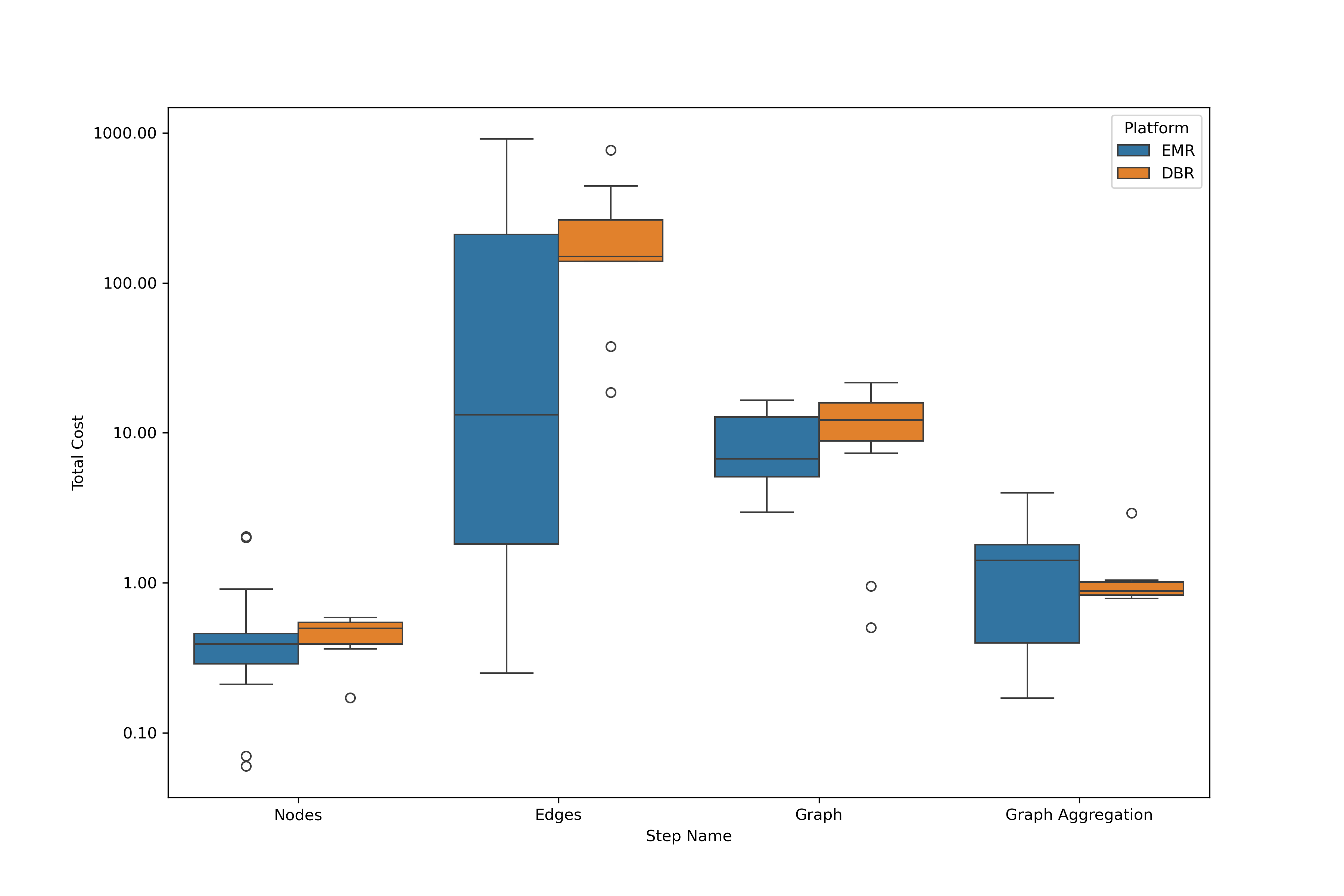 {#fig:costProduction}
Figure [@fig:costProduction] shows costs across multiple Common Crawl batches whereas [@fig:durationProduction] compares step durations. Taken together, these results visualize the trade-off between platforms for different tasks. DBR had the fastest times due to its optimized runtime. It uses an optimized Spark version and a C-based rewrite (Photon). DBR’s pre-configured settings improve usability and efficiency. They eliminate the need for extensive manual tuning required with EMR. This further underscores DBR’s cost-effectiveness in resource and time savings.
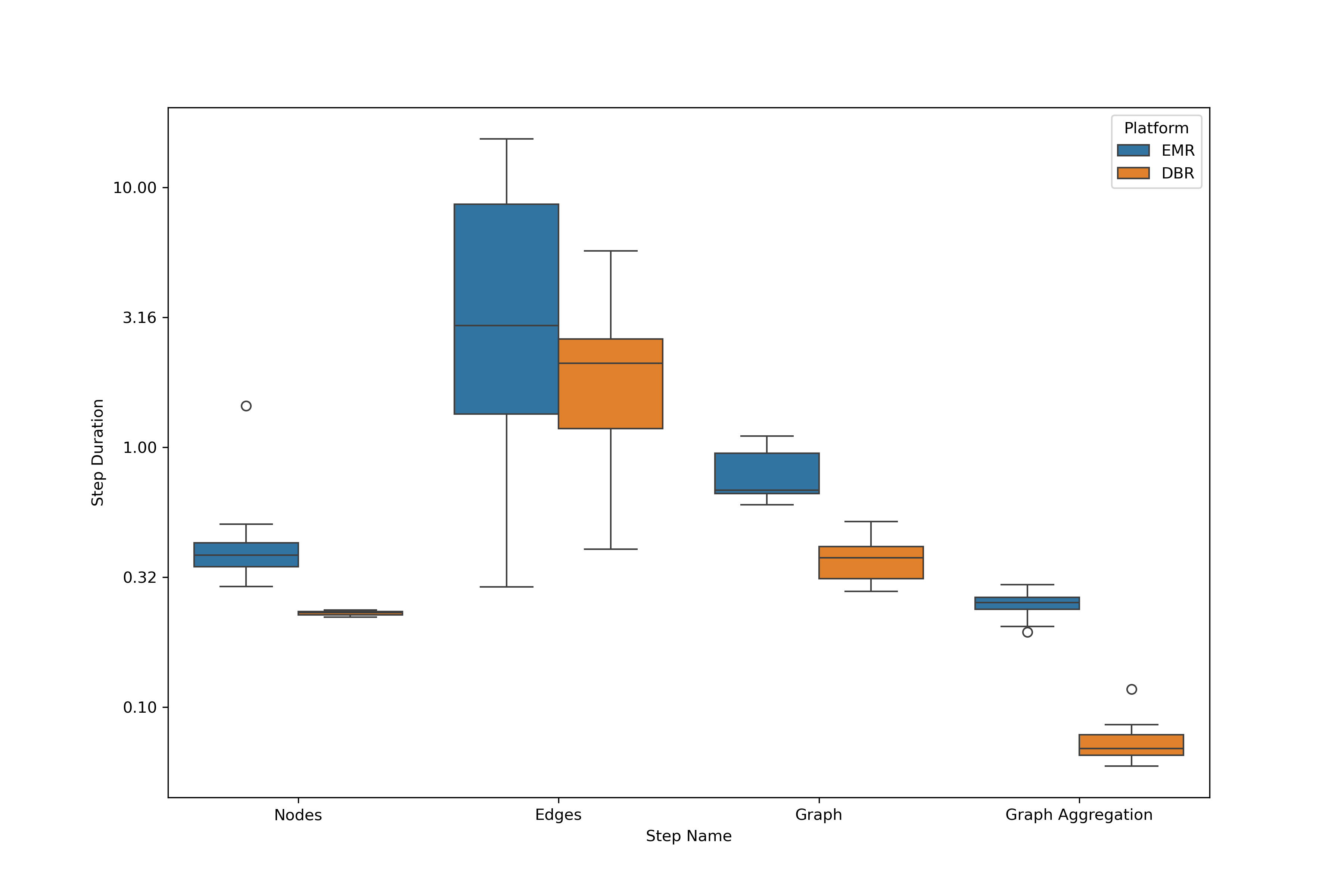 {#fig:durationProduction}